

Arriving in Konya, we are welcomed in the true spirit of Rumi. We hadn’t actually planned to arrive in the middle of the night. And we certainly hadn’t expected that the Sufi guesthouse where we stayed four years ago would have closed in the meantime.
When we ask where we might pitch our tent—since a hotel is beyond our budget—we’re directed to a parking lot.
“Huh? Wait… what?”
We’re supposed to sleep right next to Rumi’s Mausoleum? In terms of location, it’s about as if we pitched our tent right in front of Hamburg’s City Hall. Or directly beside the Brandenburg Gate in Berlin.
Okay. Let’s do it. 🙂 I find the whole thing only slightly amusing.
Our initial uneasiness fades as we notice that the people still walking by at this late hour don’t even give us a strange look. There we are, standing in our sweaty bikepacking clothes. Our bodies haven’t seen soap in several weeks. We pitch two tents in the heart of Konya, and we’re greeted with nothing but respect and a warm welcome..
Come, come, whoever you are.
Wanderer, worshiper, lover of leaving—it doesn’t matter.
Ours is not a caravan of despair.
Come, even if you have broken your vows a thousand times.
Come, come again, come.(Rumi)
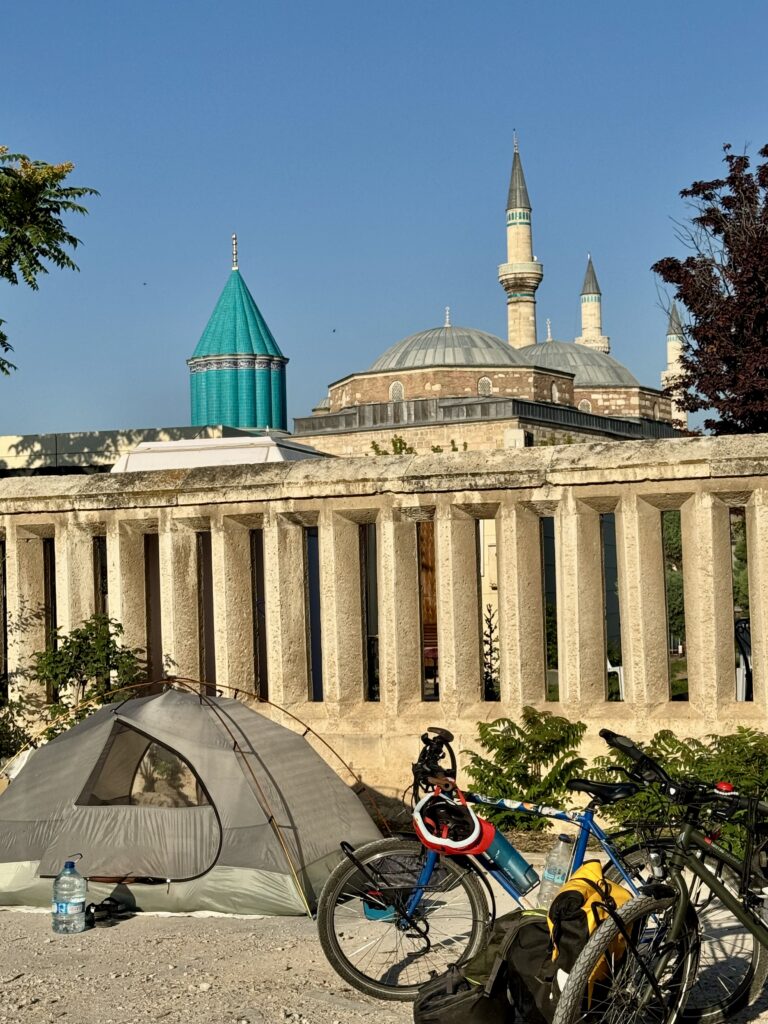
Not only that. We are also asked if we need anything. Only this time, it isn’t the police silently driving past us.
It somehow feels fitting for this place, where Rumi lived, loved, taught, and also suffered. It must have caused him deep pain to watch, as a highly respected scholar and spiritual teacher, how his own followers could not accept his friendship, closeness, and profound spiritual love for a simple wandering mystic.
Until the day his beloved Shams of Tabriz disappeared without a trace. Some even believe he was murdered.
But let’s slow down for a moment: Who was Rumi, really? And why do we love him so much?
Of course, I could tell you his life story. That he was born in 1207, had to flee the Mongol invasion as a child, and eventually became one of the most respected Islamic scholars of his time in Konya. All of that is true. But his spirit is so much more than the facts of his biography.
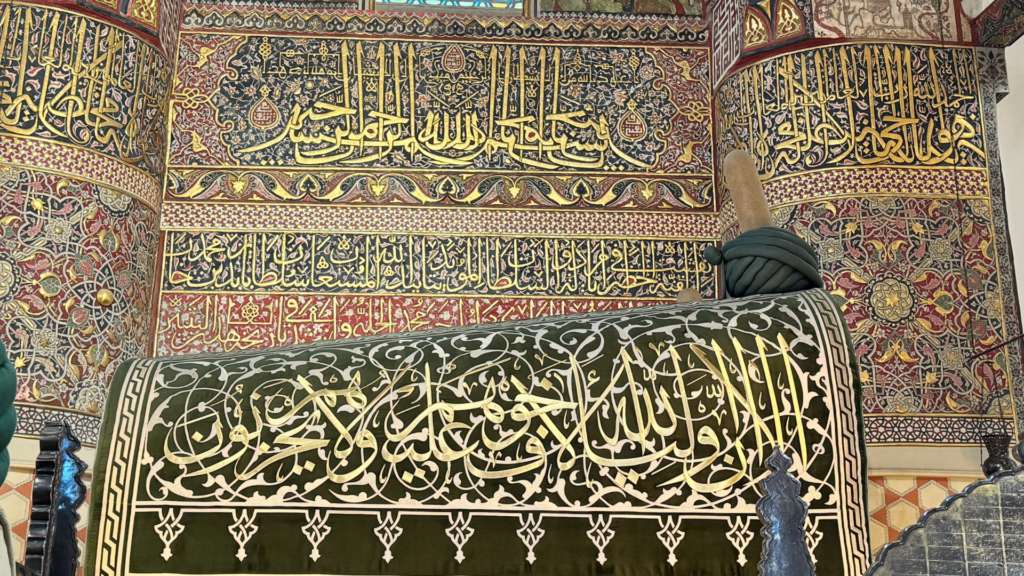
As I stood before his tomb, tears began to stream down my face. Something deep inside me started to tremble, just as it had four years ago when I stood here for the very first time. In front of Rumi’s resting place, my thinking quietly steps aside, and something else takes over. Something I can hardly put into words. Something greater. Greater than anything else.
Four years ago, I experienced exactly the same thing in this very place. Back then, I thought perhaps it was because we had walked the entire 800-kilometre Sufi Trail with two of our three children. This time, I arrived by bicycle. A completely different journey. A different chapter of my life. And yet that same deep touch was there again instantly.
I am also moved by the hundreds of thousands of people who make the pilgrimage to Konya every year. I sense that they don’t come simply because a famous poet is buried here. They come because many feel that something of Rumi’s heart is still alive today.
Rumi’s life changed profoundly when he met the wandering mystic Shams of Tabriz. Many stories have been told about their encounter, though very little is historically certain. Today, in Konya, a statue stands at the place where they are said to have met for the first time. It is called “The Union of the Two Seas.”
I love this statue and everything it symbolizes. But what moves me most is that it stands in the very place where Rumi and Shams are believed to have first encountered one another.
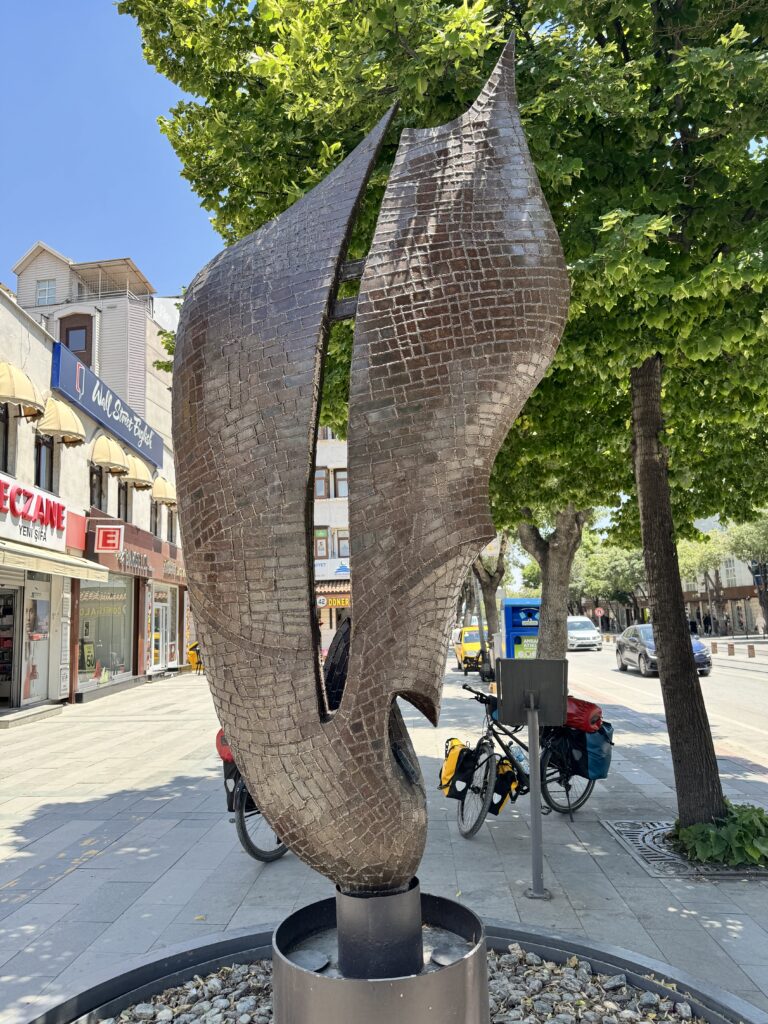
Two seas lose nothing of themselves when they flow together. They do not need to decide which one is right. They simply become greater.
This is exactly how I imagine the meeting between Rumi and Shams. A highly respected scholar encounters an unconventional wanderer who cares neither for status nor for society’s expectations. Instead of defending his own way, Rumi allows himself to be transformed. He does not become less. He becomes more expansive.
There is a story that Shams once prayed to God, “Show me someone who can bear my company.” In response, he was given the name Rumi. And when God asked what he was willing to give in return, Shams answered, “My head.”
To me, this is about far more than physical death. It speaks of a willingness to let go of one’s ego, reputation, and even one’s former life if love and truth require it. Wow. That is immense.
From the friendship between these two men came poetry that continues to touch millions of people today. Rumi’s greatest work, the Masnavi, begins with the words: “Listen to the reed flute, how it tells its tale. It speaks of separation…” For the Sufis, the reed flute symbolizes the human soul. Just as the reed was cut from the reed bed, we too long to return to our true source. Rumi even spoke of death as “the union with the Beloved.”
The more I learn about Sufism, the more I discover something that deeply resonates with me as a Buddhist meditation teacher. Sufism is not a separate religion but a mystical tradition within Islam. At its heart is not the dance of the whirling dervishes, but love. A longing to draw closer to the Divine through poetry, music, calligraphy, prayer, hospitality, and the quiet beauty of everyday life.
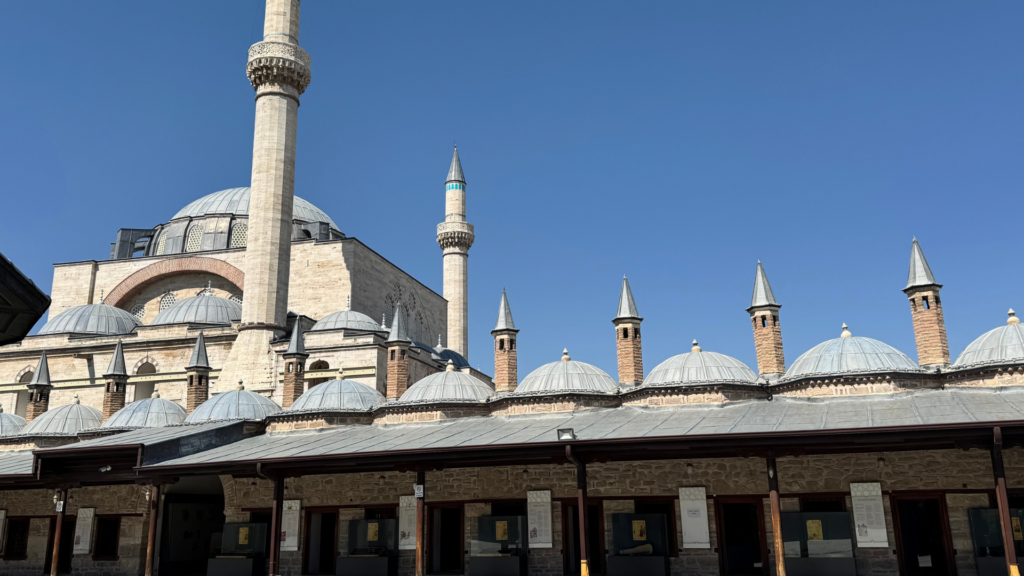
One thing that touched me deeply was learning that, in the Mevlevi monastery, even the kitchen was considered one of the most important places of spiritual practice. Cutting vegetables, baking bread, or sweeping the floor was approached with the same mindfulness as meditation or the whirling dance. That feels surprisingly familiar to me. In Buddhism, too, practice does not end on the meditation cushion. It begins wherever we meet life.
Shortly after Rumi’s death, the Mevlevi Order was founded. For almost 650 years, dervishes lived here in Konya. They studied, made music, wrote poetry, welcomed guests, practiced the Sema, and sought to turn their entire lives into a spiritual path.
In 1925, all dervish orders were banned in Turkey, and the monasteries were closed—including this one. And yet, some things seem impossible to forbid. Rumi is everywhere today: in schools, on posters, in bookshops, and above all, in people’s hearts. Sufism continues to live on through associations and spiritual communities, quietly enduring despite its turbulent history.
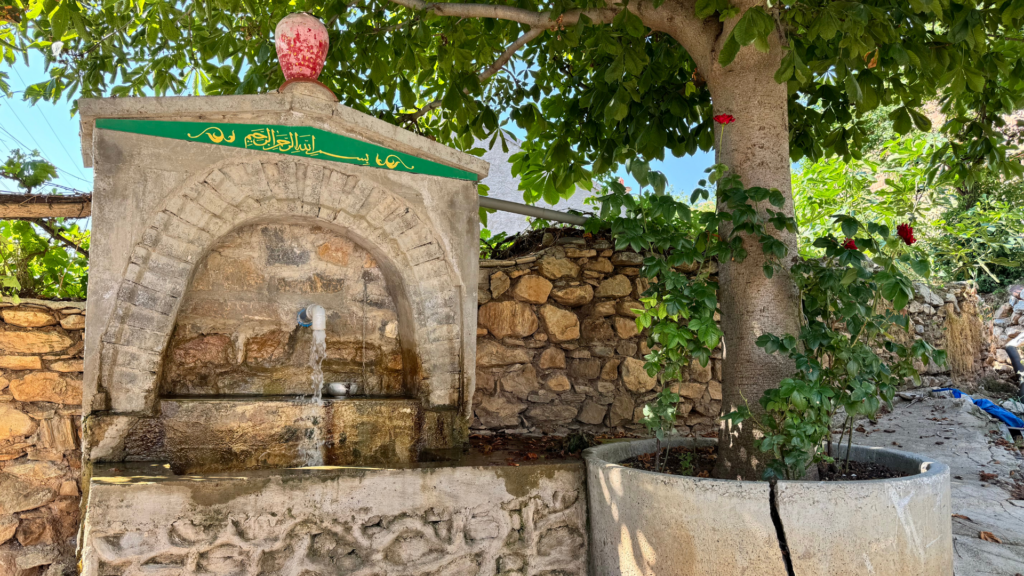
Rumi’s love is still alive. In the heart of Konya stands this statue: The Union of the Two Seas. It completely blows me away.
Rumi’s most important message cannot be explained in a museum. It continues to live wherever people meet one another with respect, without first asking where they come from, what they believe, or whether they fit into a particular identity.
Rumi’s religion was love. To me, the entire square surrounding his mausoleum seems to vibrate with it. What a gift it is to share these moments with all the people who come here from every corner of the world to visit his resting place.
“Out beyond ideas of wrongdoing and rightdoing, there is a field. I’ll meet you there.” — Rumi
➡️ If you like, follow us on Instagram for daily (almost) posts.
➡️ If you feel like supporting our journey, you are so welcome! We live really low budget, and your donation enables us to buy a fresh juice from time to time, do some repairs on the bicycle or maybe even to book a hotel for a night. You can donate via this link: GoFundMe Link. Thank you! We really appreciate it! 🧡
➡️ If you like, you could explore Nirmals‘s website. She is offering meditation and yoga classes based on donations. www.soulteachings.de