
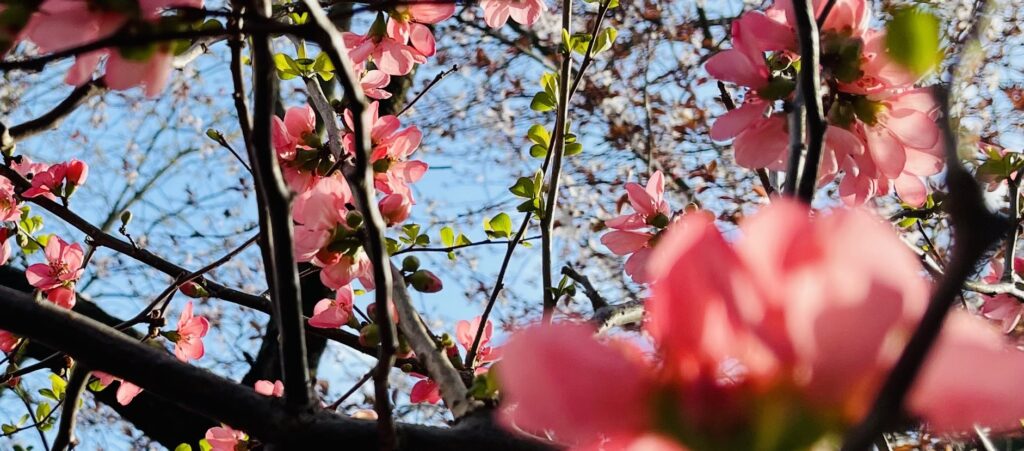
It is the end of March, and the blossoming life all around us does not make saying goodbye any easier.
We are not only leaving behind a house and dear friends, but also our community, the Lebensgarten Steyerberg, where we have spent the last seventeen years of our lives. This is where our children grew up, where we built the businesses we love, and where we experienced countless meaningful friendships, celebrations, and moments of grief and joy.
Looking back, we may have approached this adventure with a touch of naivety.
When our plan to cycle around the world became definite a year ago, we assumed that sponsors would naturally appear—companies eager to support us with equipment, bicycles, publicity, or funding. What we hadn’t considered was that there are many people out there doing extraordinary cycling expeditions right now: crossing deserts, riding through Africa’s rainy seasons, or traversing the Himalayas.
Still, we were deeply touched by the responses we received. Many companies replied with warmth and encouragement. In some cases, we could sense they genuinely wished to support us but simply didn’t have the resources to do so.
As a result, a significant part of our savings is currently going into equipment. Petur and Lukas found second-hand bikes, but for Nirmala we need to buy a new one. That’s why we decided to start a GoFundMe campaign.
Somewhere along the way, many of us learned that asking for help is something we shouldn’t do. We noticed this belief in ourselves as well. Yet when we looked more closely, we found ourselves laughing at some of our assumptions about money, giving, and receiving.
For us, asking for support is not the difficult part.
The more interesting question is: What will others think?
Because the truth is: we genuinely enjoy being asked for support.
Whenever someone trusts us enough to share a need, we experience it as a gift. We feel grateful when we have the opportunity to contribute—whether through money, time, practical help, or simply our presence.
When Nirmala travels through cities such as Hanover or Bremen, she often makes sure she has coins in her pockets for people asking for money on the streets. We don’t spend much energy judging what people do with our contribution. After all, we rarely know what anyone ultimately does with the money we give them.
And what is “my” money anyway?
Isn’t it simply something that moves through the world, constantly changing hands?
What would happen if we had a softer relationship with money? If we shared whenever we could? What might change if more of us practiced generosity whenever the opportunity arose?
And who would we be if we loosened our grip on our ideas about giving and receiving?
If any of this feels uncomfortable or triggering, perhaps take a breath and see if you can continue reading from a place beyond right and wrong.
Both of us were fortunate to grow up with generous parents. Not perfect parents, of course, but generous ones. And generosity is not only about money. It is also the ability to make others feel safe, welcomed, and at ease. Lukas has always had that gift. (One of the many reasons I, Nirmala, fell in love with him.)
My own understanding of generosity deepened through Buddhist practice.
For several years I spent time in Buddhist retreat centers in India and Sri Lanka, places where no one ever asked me for money. It was simply understood that those who benefited would contribute according to their means. People supported the meals, the teachers, and the maintenance of the retreat centers because they genuinely valued what they had received.
I loved that culture of generosity.
The practice brought me so much joy, insight, and wisdom that I naturally wanted others to have access to it as well.
In Buddhism, generosity is the first of the ten qualities that open the heart. This is not merely a philosophy—it is something that can be directly experienced.
When life feels difficult, give.
Offer kindness. Offer safety. Offer food, shelter, patience, understanding, or a listening ear. Offer tolerance. Be generous with another person’s imperfections.
As the Buddha is said to have taught:
If you knew what I know about the power of giving, you would not let a single meal pass without sharing it in some way.”
Have you ever noticed that some of the most beautiful things in life are free?
A sunset.
The laughter of a child.
The sound of leaves dancing in the wind.
Birth.
Love.
Joy.
Tenderness.
And if we will all leave this Earth empty-handed one day, why is letting go so difficult?
None of what we accumulate can come with us.
Sooner or later, we leave it all behind.
Perhaps this journey is also an invitation for us to discover what it means to live with less. Really less.
Everything we own will need to fit onto our bicycles.
No abundance.
No endless choices.
No backup options.
Just the essentials.
And yet, what we carry with us will still be more than many people in this world possess.
We know from previous travels that contentment and possessions are not necessarily connected.
I remember a train journey in India. I had a bed, my own space, and what looked like comfort. Yet I couldn’t sleep. Around me were people lying on crowded floors with far less than what I would have considered the minimum—and they slept deeply and peacefully.
Perhaps this journey is not only about cycling around the world.
Perhaps it is also about questioning our ideas of comfort, security, and what is truly enough.
What remains when familiarity, certainty, and convenience fall away?
Whether this journey is financially supported or not, one thing is clear: no one does anything alone.
Not this journey.
Not even ordinary life.
Who made the clothes you are wearing?
Who grew the materials, transported them, stitched them together?
How do those people live? How do they care for themselves and their families?
Even the chair you are sitting on is made of earth, water, sunlight, and air.
We are far less separate than we often imagine.
Our lives are woven together in countless visible and invisible ways.
And so we are grateful to begin this journey with you.
We look forward to sharing our adventures, our love, our discoveries, and our joy along the way.
Thank you for reading. 💛
A few reflections, if you feel inspired:
• Think of someone who is generous. What qualities do they embody?
• What thoughts or judgments arise when someone asks for support?
• Did you learn that giving or receiving should come with conditions?
• Is it easier for you to give or to receive? Why?
• What stories do you tell yourself about money, support, and deserving?
• What happens inside you when someone openly asks for help?
• Does it touch a part of you that longs for more support itself?
• What experiences have shaped your relationship with generosity?
By the way, Nirmala offers donation-based yoga and meditation classes. If you’d like to learn more, feel free to visit her website.
➡️ And if you enjoy reading our articles and like to support our journey, you’ll find more information here on our website.