
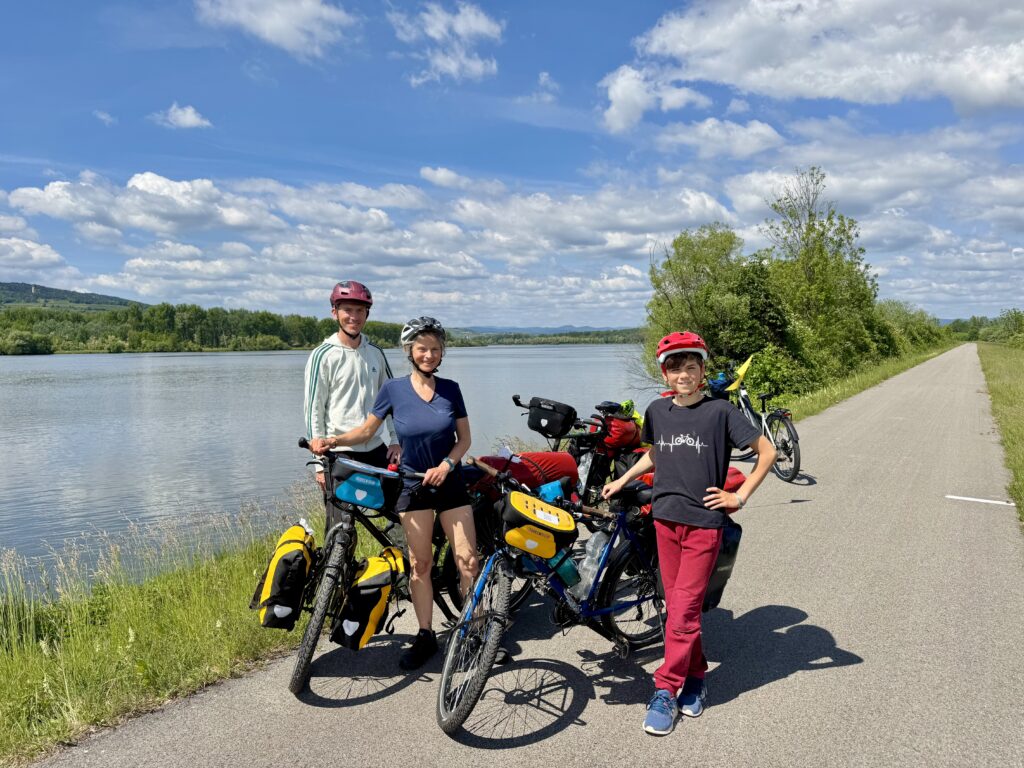
As I sit on a bus from Belgrade to Vienna, retracing in a few hours a route that took us two weeks to cycle, I find myself reflecting on the past five weeks. Once again, we cross the Serbian-Hungarian border. This time, however, everything takes much longer. The European Union has fortified itself here. The fence seems endless, and no one passes without scrutiny.
I am on my way back to northern Germany to teach a silent retreat at the House of Silence. The income matters. Even though we live on very little, we still have responsibilities, including supporting our two older daughters as they find their way in the world.
Five weeks ago, I barely owned a bicycle. I hadn’t ridden regularly for years, and my body still remembers that fact—especially my backside. During those first weeks, progress felt slow. The weather was cold and rainy, and my body seemed made more of to-do lists and daily routines than of cycling muscles. Fortunately, my son quickly realized that riding 100 kilometers a day was not going to happen with me, and he reluctantly adjusted his expectations.
Our goal for now is to reach Asia before slowing down and spending more time in individual countries. Yet even while moving quickly, we experience each place in a very raw and immediate way. We sleep on the ground, sometimes so exhausted that we simply lie down on sandy soil in light rain without even unpacking a sleeping mat. Afternoon naps have become an important part of our journey.
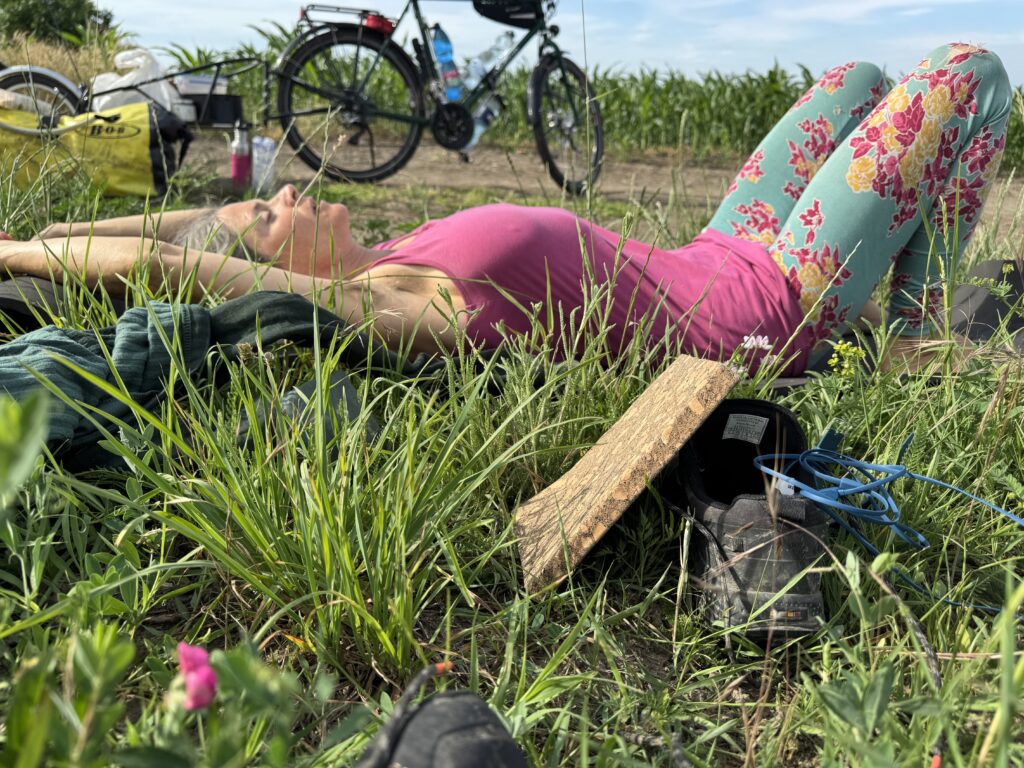
The irony is that slowing down is one of the qualities I love most. It brings me back to what matters. Gathering wild cherries and mulberries, swimming in the Danube, washing dishes with sand, grass, and river water, and living with only the essentials reminds me how little is actually needed for a good life. After five weeks, something inside me has become remarkably clear. Our diet consists mostly of oats, lentils, nuts, cherries, and mulberries. The simplicity feels cleansing. My heart feels more open. I find myself taking more time with people, looking into their eyes more easily, and allowing life’s inner and outer weather to move through me, much like in meditation.
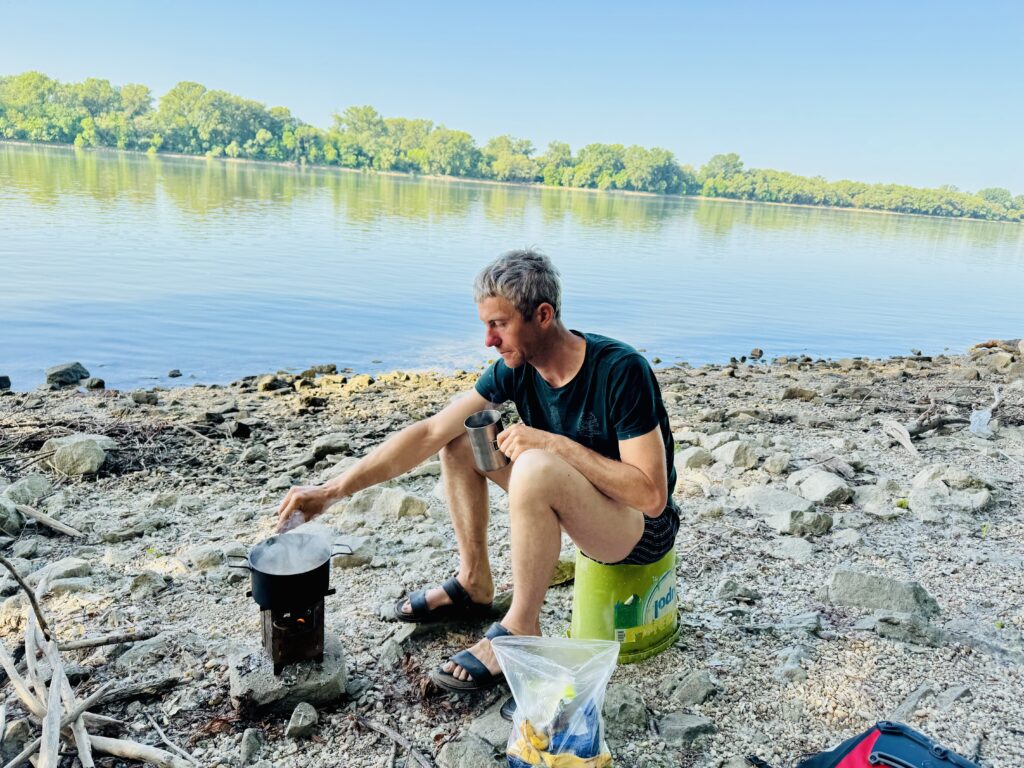
Conflict, too, has become easier. At home, I often escaped into the forest whenever tension arose. Now there is nowhere to escape to except the road itself, and perhaps that is a gift. Everything changes so quickly when you are travelling that even disagreements lose their solidity.
The landscapes change as well. Southern Hungary feels endlessly flat, while large parts of Serbia are dominated by vast monocultures stretching to the horizon. We often joke, “Nobody will see us if we camp here,” while pitching our tent in the middle of an open field with nowhere to hide. Not a bush in sight. The land feels highly controlled, every plant carefully managed. It is certainly not the place where we would want to gather wild herbs for dinner.
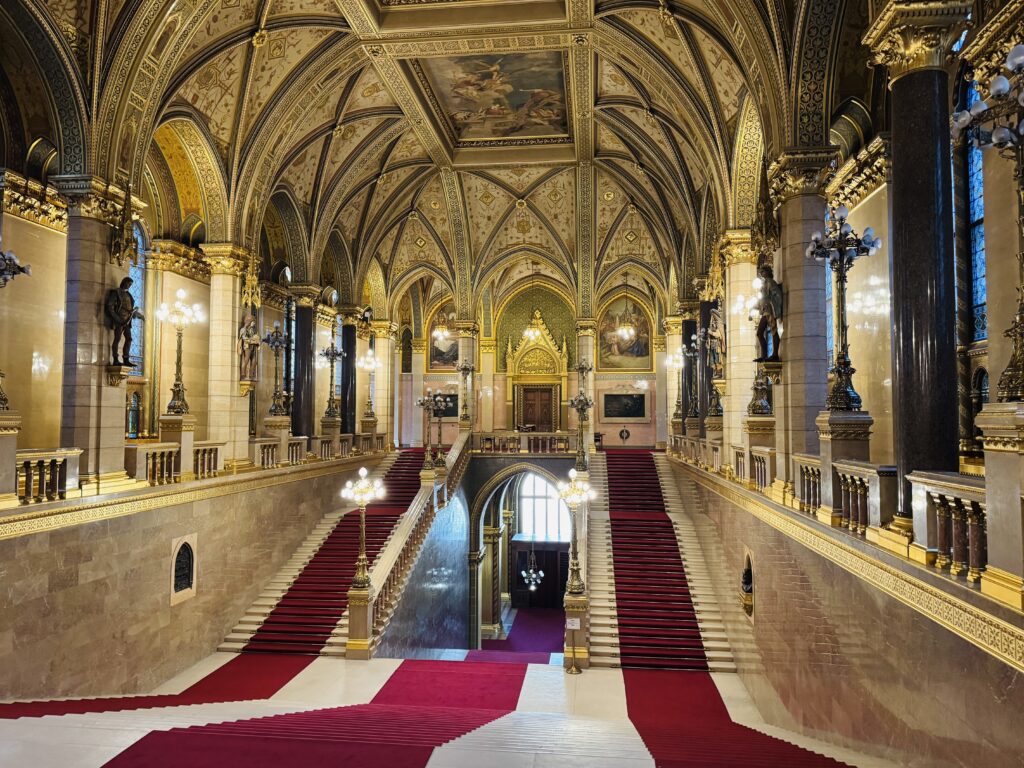
Along the way we continue learning. In Budapest, my son and I visited the Hungarian Parliament building, one of the largest and most impressive parliamentary buildings in the world. Later, in Belgrade, we spent a day at the Nikola Tesla Museum. Petur was fascinated by the life and work of the visionary inventor whose ideas laid the foundations for much of our modern technological world.
One of the highlights of our time in Budapest was staying with a Warmshowers family. Warmshowers is a hospitality network where cycle travellers host one another. Our hosts had spent four years cycling around the world on recumbent bikes. Naturally, we ended up kneeling over a giant world map late into the night, sharing stories and dreaming about roads yet to come. Their home was filled with photographs from their journey. My favourite was the one showing them arriving back home.
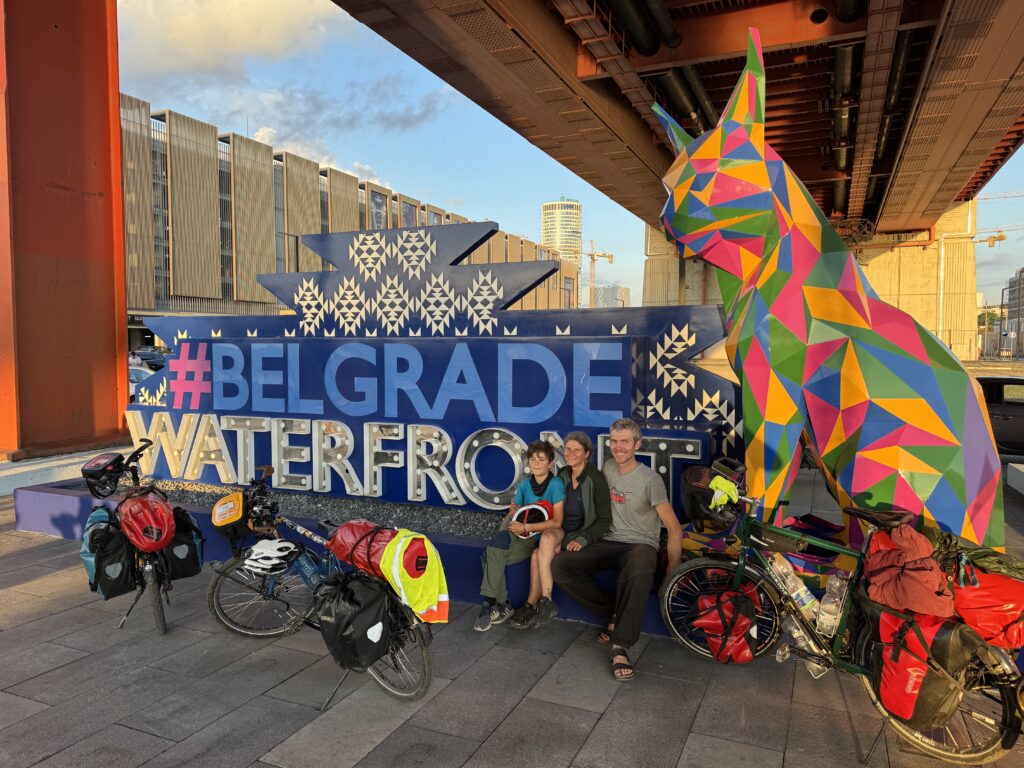
This trip is also a journey through European history. Following the Iron Curtain Trail and parts of EuroVelo 6, we travel through landscapes shaped by borders, wars, and political divisions. Along the way, personal memories surface. As a child, I repeatedly crossed the border between East and West Germany with my father. My mother, however, was not allowed to return to visit her family in East Germany for thirteen years after emigrating to the West in 1975. She could not even attend her own father’s funeral.
I remember border searches where our entire car was dismantled. I remember stories of relatives imprisoned by the Stasi. And I remember sitting in front of the television as a thirteen-year-old when my mother suddenly pointed at the screen and exclaimed, “That’s Marlies!” It was a friend she had not seen since leaving East Germany. She appeared among the thousands of East Germans gathered at the West German Embassy in Prague, hoping for permission to leave. A few months later, the Berlin Wall fell. Our family celebrated in front of that same television.
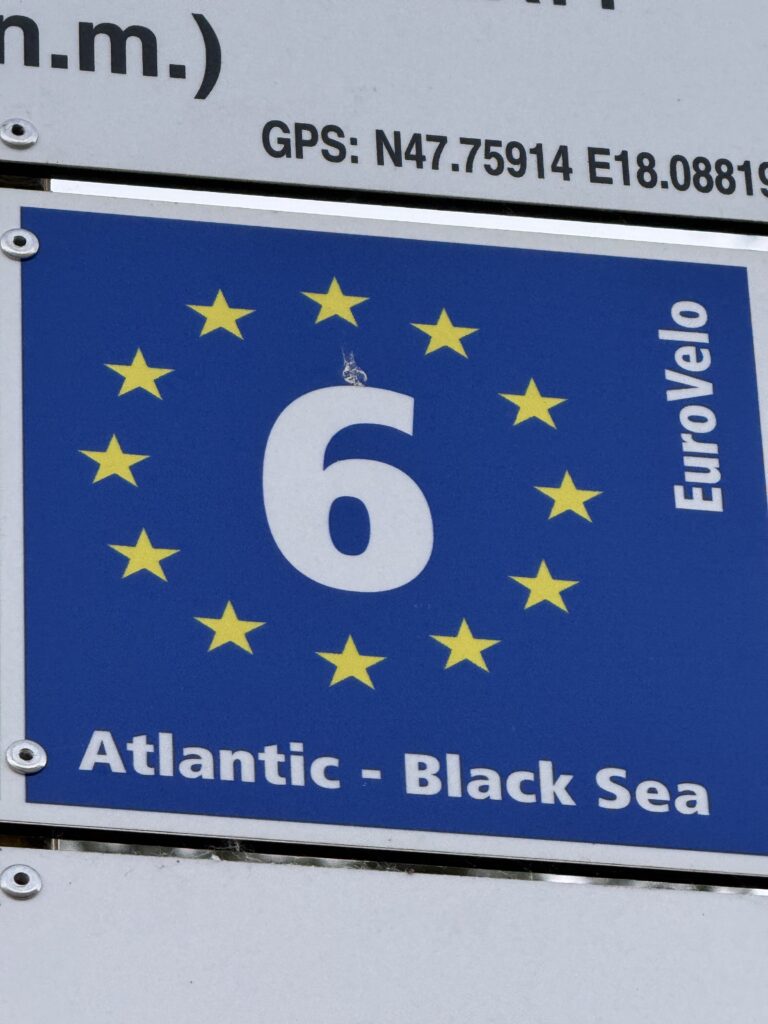
Today, travelling along these routes, I am reminded how recent freedom of movement really is. We often take it for granted, forgetting that for millions of Europeans it was restricted or impossible only a few decades ago. The fence at the Serbian-Hungarian border brought that realization home once again. It also reminded us of our immense privilege. We can cross borders with relative ease, while many others spend years hoping for the same opportunity.
This journey has become more than a bicycle trip. It is a passage through landscapes, histories, and memories. We ride through places where people, like everywhere else, want the same things: love, safety, belonging, dignity, and a chance at a good life. Perhaps that is what connects us across all borders, nations, and generations—the simple human longing to be free, to be seen, and to find our place in the world.
The overnight bus carries me from Belgrade to Vienna in just a few hours. The same distance that took us two weeks to cycle. Yet it feels as though the bicycle journey covered far more than geography. Along the way we crossed stories, memories, and invisible boundaries. Some have fallen. Others have been newly built. All of them tell us something about who we were, who we are, and who we might become.
➡️ You can follow our journey almost daily on Instagram.
➡️ If you enjoy reading these articles and travelling alongside us through these stories, we are deeply grateful for your support. Your donation helps us cover the occasional campsite or guesthouse, enjoy an ice cream on a hot day, and keep our bicycles and equipment in good shape. You can support us through this page. Thank you so much for being part of this adventure. 🧡
➡️ If you’re interested in Nirmala’s donation-based online yoga and meditation offerings, you’re warmly invited to explore her website at soulteachings.de.